Milford Haven waterway · Pembrokeshire
Pembroke Dock: dockyard history, flying boats and visiting the hangar town that built the Millennium Falcon
A town drawn up around a royal dockyard, then home to one of the great flying-boat stations of the Second World War. This is a walk through its history, its two most famous aircraft stories and the best way to spend a day there now.
A hull on the stocks at the end of the working day. The town began with ships, not the other way round.
Chapter 01 · 1814–1926
Pembroke Dock history: the Royal Dockyard, 1814–1926
Pembroke Dock history begins with a dockyard. The town came afterwards, and for more than a century it lived by the work on the slips.
A royal dockyard was established here in 1814, across the haven from Milford. At first many of the workmen came in by boat from nearby communities; as the town was built up, it became home to the people who worked in the yard. The dockyard was the reason the place existed, and for more than a century it set the rhythm of daily life, from the hours people kept to the trades their children learned.
The output was remarkable for a yard so far from London. Over 260 Royal Navy vessels were built here across the dockyard's working life, and five royal yachts besides. That says a good deal about the standing the yard held: this was not a minor repair station on the edge of the map but a place trusted with prestige work as well as the steady business of building warships.
That long run ended in 1926, when the dockyard closed. For a town built around a single employer the closure was a hard blow, and the years that followed were difficult for many families. Yet the deep, sheltered water that had suited shipbuilding had other uses. Within a few years the haven would fill with aircraft instead of hulls on the slips, and the town would find a second identity on the same shoreline.
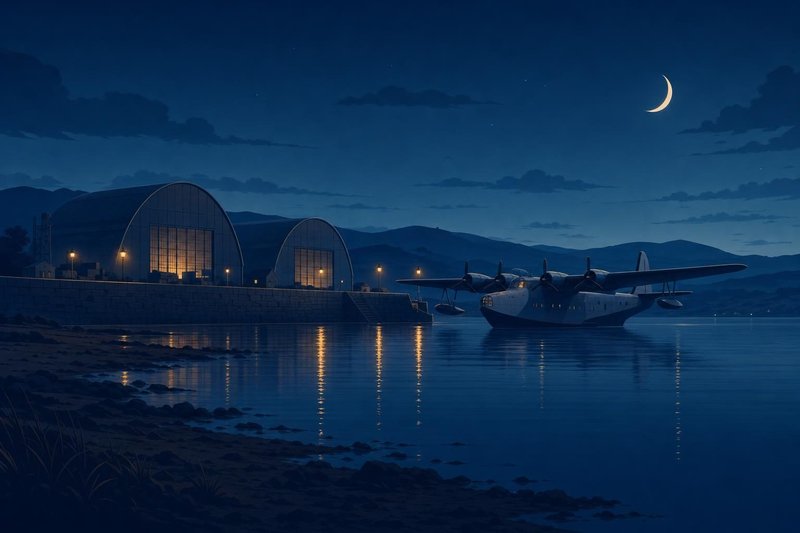
Flying boats ride at their buoys on the water where the slips once launched warships.
Chapter 02 · 1930–1959
Pembroke Dock flying boats: the RAF years, 1930–1959
On 1 January 1930 the Royal Air Force arrived, the era of the Pembroke Dock flying boats began, and the haven became a runway made of water.
Flying boats needed what the waterway offered: a long stretch of sheltered water for take-off and landing, with room to moor aircraft close to the shore. The old dockyard site was put to new use, and large hangars came to stand along the waterfront to house the aircraft that came ashore.
The aircraft most closely tied to the station is the Short Sunderland: a big four-engined flying boat with a deep hull, a high wing set on top of the hull and stabilising floats under each wing. Moored out in the haven, Sunderlands became a familiar sight from the streets of the town and from the high ground above it, as much a part of the view as the dockyard wall.
During the Second World War Pembroke Dock became one of the largest operational flying-boat bases in the world. Its Sunderlands guarded the Western Approaches, flying long patrols out over the Atlantic and watching for submarines along the sea lanes on which Britain depended. The work was slow and exposed, hour after hour of grey water, and the weather could be as dangerous as anything the crews were sent to find.
After the war the station's role shrank. The last flying-boat squadrons were disbanded in 1957, and the RAF left Pembroke Dock in 1959, closing nearly three decades of flying from the haven. The hangars stayed on the shore, and one of them would later have an unexpected second career.
One aircraft is still in the haven. A storm in 1940 sent it to the bottom.
Chapter 03 · 1940
T9044: the Sunderland on the seabed
Not every loss at a flying-boat base happened in the air.
In 1940 a fierce storm swept the haven, and the Short Sunderland T9044 sank there. An aircraft built to work far out over the open Atlantic went down in sheltered water, close to the shore it flew from.
The wreck then lay on the seabed for decades, in water around 18 metres deep. It was rediscovered in the 2000s, and parts of the airframe have since been lifted and cleaned so that they can be put on display. Seeing metal from a single named aircraft, rather than a photograph of the type, gives the flying-boat years a weight that general histories rarely reach.
The full account of the sinking, the search and the recovery has its own page, and the work under water in the haven produced a second story worth reading alongside it.
Light spills from a flying-boat hangar. Something round and enormous is taking shape inside.
Chapter 04 · 1979
The Millennium Falcon in the hangar
Two decades after the last RAF flying boats left, one of the old hangars was put to a very different use.
In 1979 the full-size Millennium Falcon for The Empire Strikes Back was built inside one of the former flying-boat hangars at Pembroke Dock. It is easy to see why a flying-boat hangar suited the job: a vast covered space beside the water, big enough to hold something enormous and keep it out of the weather while it was made.
It is a pleasing loop in Pembroke Dock history. A shoreline that launched warships and sheltered flying boats also sheltered the most famous starship in cinema, assembled under a roof that had been designed for aircraft. For a town that had already lived through the end of the dockyard and the departure of the RAF, it was a reminder that its buildings and its waterfront could still surprise people.
Local memories of the build, and of the moment people realised what was being put together behind the hangar doors, are gathered in a separate piece.
The dockyard wall, the towers and the hangars are still here, and all of them can be walked.
Chapter 05 · What to see
Visiting Pembroke Dock today: what to see
The town keeps much of its working past in plain view, and visiting it on foot shows nearly all of it.
The natural starting point is the heritage centre, the Pembroke Dock museum in the former dockyard chapel, which brings the dockyard and the Pembroke Dock flying boats together under one roof and makes sense of everything you will see outside. From there the town opens up in every direction.
Heritage centre
Housed in the former dockyard chapel, the Pembroke Dock museum is the place to get your bearings before walking. More on the heritage centre.
Dockyard wall
The dockyard wall is still substantially complete. Following it is the simplest way to understand how large the royal yard was.
Gun towers
Two Martello towers still stand by the old yard: the South West and the North East tower. Seeing both helps explain how seriously the dockyard was protected.
Defensible Barracks
Work on the Defensible Barracks began in 1844. From there the view runs back over the former dockyard.
Hobbs Point
A listed causeway on the waterfront, with open views along the water.
The waterfront
The long line of the shore and the great hangars: the setting for every chapter of the town's story.
When visiting, none of these sights needs long explanation once you have stood in front of them. The scale of the dockyard wall and the size of the hangars do most of the work, and the view from the Defensible Barracks ties the whole place together.
Chapter 05 · Getting there
Plan the day
Pembroke Dock is easy to reach without a car. By rail, Pembroke Dock station sits at the end of the branch line, so the train delivers you into the town itself rather than to a junction miles away. From Ireland, ferries link the port with Rosslare, which makes the town a natural first or last stop on a crossing.
By road, the A477 brings traffic in from St Clears in the east, and the Cleddau Bridge, opened in 1975, carries the same road across the river from Neyland. Crossing the bridge is a good way to arrive: the haven opens out on either side, and you see the town and its waterfront before you are in it.
A half-day on foot covers the essentials. One route that works well:
- The station
Start where the branch line ends and walk down toward the water.
- The heritage centre
Get your bearings in the former dockyard chapel.
- The dockyard wall
Follow the boundary of the old yard and read the town's plan from it.
- The Martello towers
Find the South West and North East towers by the old yard.
- Hobbs Point and the waterfront
Walk the shore past the hangars and look out over the haven.
- The Defensible Barracks
Finish at the barracks for the view back over the former dockyard and everything you have seen.
Route order is a suggestion. Check transport times with the operators before you travel.
Chapter 06 · From the log
Stories from the haven
Longer pieces on the people, aircraft and buildings of Pembroke Dock. Each window opens one story. All stories.
- 01T9044: the Sunderland on the seabedThe storm of 1940, the wreck in the haven and the parts brought back up.Read
- 02Welsh memories of the Millennium FalconHow a flying-boat hangar became a film workshop in 1979.Read
- 03The Vickers gun and the diversA gun brought up from the haven, and what it tells us.Read
- 04A D-Day chapel servicePembroke Dock at the time of D-Day, remembered in the dockyard chapel.Read
- 05Fleets to flying boatsThe heritage centre in the former dockyard chapel.Read
- 06Pembrokeshire's claims to fameThe county's best-known stories, gathered in one place.Read
- 07A brief history of the townFrom the royal dockyard to the flying boats, in short.Read
Questions
Questions about Pembroke Dock
Q.01Where is Pembroke Dock?
Pembroke Dock is a town on the banks of the River Cleddau, on the Milford Haven waterway in Pembrokeshire, west Wales. It grew up around the royal dockyard established there in 1814 and later became an RAF flying-boat station.
Q.02Why is Pembroke Dock linked with flying boats?
The RAF arrived in 1930, and the sheltered water of the haven suited flying boats. During the Second World War it became one of the largest operational flying-boat bases in the world, home to Short Sunderlands guarding the Western Approaches. The RAF left in 1959.
Q.03What happened to Sunderland T9044?
T9044, a Short Sunderland, sank in the haven during a storm in 1940. The wreck lay on the seabed for decades until it was rediscovered in the 2000s, and some parts have since been lifted for display. The full T9044 story.
Q.04Was the Millennium Falcon really built in Pembroke Dock?
Yes. In 1979 the full-size Millennium Falcon for The Empire Strikes Back was built inside one of the former flying-boat hangars at Pembroke Dock, the eastern one.
Q.05How do I get to Pembroke Dock?
By train to Pembroke Dock station at the end of the branch line from Swansea, by ferry from Rosslare, or by road on the A477 and across the Cleddau Bridge, which opened in 1975.