History · From farmland to dockyard town
Pembroke Dock history in brief: a timeline from the royal dockyard of 1814 to the town today
Two centuries ago there was no town here, only a few farms and a ruined tower. Then the Admiralty needed somewhere to build ships.
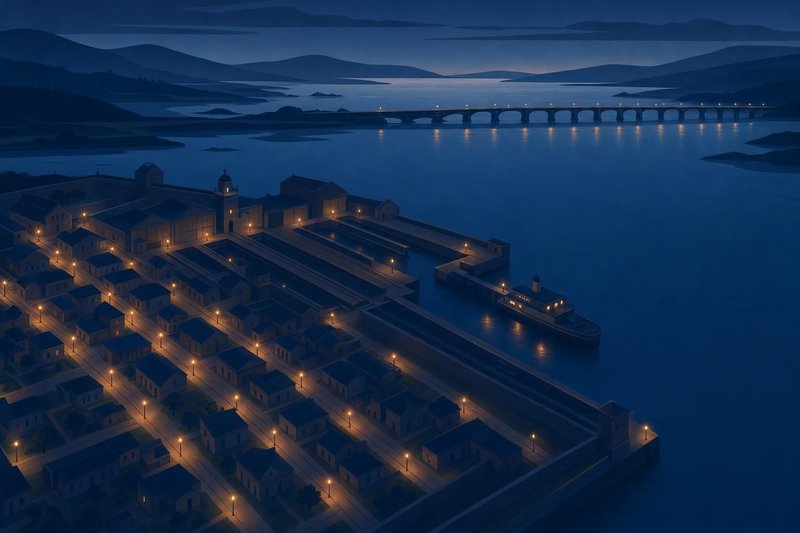
Pembroke Dock history is short by Welsh standards and unusually tidy: the town has a founding year. Before 1814 the land on the south shore of the haven was farmland called Paterchurch, first recorded in 1289, with a medieval tower that was already mostly ruined by 1802. What followed is told here in brief, from the Pembroke Dock royal dockyard to the flying boats, the bombing raids and the ferry port of today, with a timeline near the end for anyone who wants the dates in one place.
Why the royal dockyard came to Paterchurch
The Navy wanted a dockyard on the haven, and the site it first used, on the Milford side, could not be bought at an acceptable price. So in 1814 the Admiralty started again on the opposite shore.
Naval shipbuilding on the waterway began across the water, in a private yard on the north side. The Navy took over its lease in 1796, and in 1809 a naval commission recommended buying it outright and making it a royal dockyard. The Admiralty failed to agree a price with the owner, Fulke Greville, and turned to land about five miles across the haven.
Paterchurch had one great advantage. Its shoreline was flat but ran quickly into deep water, which made it one of the few places on the haven where a dock for sizeable ships could be built. The Board of Ordnance already held 50 acres there, and a further 20 acres were bought from the Meyrick family for £5,500.
The yard was founded in 1814, although the Prince Regent did not sign the Order in Council that formally authorised it until 31 October 1815. Until 1817 it was known as Pater Yard. The name changed at the request of the Mayor of Pembroke, two miles away, who asked for it in deference to the older town.
The start was improvised. The old frigate Lapwing was beached and used as office space, and in 1832 the hulk of the 74-gun HMS Dragon was run aground to house the Royal Marine garrison. Many of the first workmen came in by boat from nearby villages, because there was nowhere yet for them to live.
A town laid out for the yard
Pembroke Dock grew because the dockyard needed workers, and it was built to a regular, planned layout rather than gathering around a market place in the usual way. That plan still shapes the town centre.
Pembroke Dock and Milford, its neighbour across the haven, were both new towns of the years around 1800, and both have planned street patterns. In Pembroke Dock the yard came first and the houses followed. The dockyard officers lived in the Terrace, a row of Georgian houses inside the walls, with the dockyard chapel standing at its end.
The town soon had its own institutions. From 1860 the dockyard was policed by a division of the Metropolitan Police, which kept that role into the 1920s. In 1864 the railway arrived, extended from Pembroke specifically to serve the yard. Pembroke Dock station is still the end of the line.
Ships and royal yachts from the slips
Over 112 years the Pembroke Dock royal dockyard launched five royal yachts and 263 other Royal Navy vessels. For a yard so far from London, that is a remarkable record.
The first launch came on 10 February 1816, when two 20-gun ships, HMS Valorous and HMS Ariadne, went down the slips together. The last was the Royal Fleet Auxiliary tanker Oleander on 26 April 1922. In between came almost every kind of vessel the Victorian and Edwardian Navy used.
A few stand out. HMS Erebus, a bomb vessel completed in 1826, later sailed to the Antarctic with James Clark Ross and was lost with Sir John Franklin’s Arctic expedition in the 1840s. Her wreck was found in Canadian waters in 2014, more than a century and a half after she left the Pembroke slips.
The royal yachts gave the yard a different kind of fame. The paddle steamer Victoria and Albert was launched on 16 January 1855 and served the sovereign until 1900. Her successor of the same name was launched at Pembroke on 9 May 1899 by the Duchess of York.
Late in the yard’s life came HMS Amphion, a scout cruiser launched on 4 December 1911. Her story is told separately in the article on HMS Amphion, because she became the first Royal Navy ship lost in the First World War.
Barracks, Martello towers and a garrison town
A royal dockyard needed defending, and from the 1840s Pembroke Dock became a military town as well as a shipbuilding one. Soldiers stayed until 1967.
Work began on the Defensible Barracks in 1844, and the first occupants, Royal Marines of the Portsmouth Division, moved in the following year. The barracks are now both a scheduled monument and a Grade II* listed building, and the former dockyard can be seen from them.
Between 1849 and 1857 two Martello towers of dressed Portland stone were built at corners of the dockyard. Each was manned by sergeants of artillery, who lived in them with their families. Both towers still stand.
On Llanion Hill a hutted camp of the 1850s gave way in 1904 to four brick barrack blocks designed for a thousand troops. They were among the most modern in the country, with separate areas for cooking and washing. A few of the Llanion buildings survive; the former officers’ and sergeants’ mess is now used by the Pembrokeshire Coast National Park.
Closure in 1926 and the flying-boat years
Pembroke Dock history turns on 1926: the dockyard closed that year, and four years later the Royal Air Force moved onto the site. For almost three decades the haven belonged to the flying boats.
After the First World War the Admiralty was short of money. In 1925 it declared the yards at Pembroke Dock and Rosyth redundant. A petition to the Prime Minister, Stanley Baldwin, warned that the town had no other employer, but the decision stood. The First Sea Lord, Earl Beatty, was blunt: as far as the upkeep of the fleet was concerned, the yards were “entirely redundant”.
The RAF arrived on 1 January 1930, and No. 210 Squadron followed in 1931 with Supermarine Southampton flying boats. In the early years the aircraft were serviced on a floating dock called HMS Flat Iron, which could sink low enough for two seaplanes to float onto it. Hangars and a slipway followed in the 1930s, and briefly the station was commanded by Arthur Harris, later head of Bomber Command.
From 1938 the Short Sunderland arrived, and it became the aircraft most closely tied to the town. In 1943 Pembroke Dock was the largest operational flying-boat base in the world, and at one point it was home to 99 aircraft. The Sunderlands guarded the Western Approaches, the sea routes into Britain’s ports. One of them, Sunderland T9044, sank in the haven in a storm in 1940 and still lies on the seabed.
Much of what is known about the station was gathered by the Pembroke Dock aviation historian John Evans. His Flying Boat Haven (1985) is an illustrated guide to the wartime RAF station, and the three volumes of The Sunderland: Flying Boat Queen, published between 1987 and 2004, are a largely photographic record of the aircraft.
The raids of 1940 and 1941
Because of the base and its fuel stores, the town was a target. The worst single episode in the modern history of Pembroke Dock was the oil tank fire at Llanreath in August 1940.
On the afternoon of 19 August 1940 Junkers 88 bombers attacked the Admiralty oil tank depot at Llanreath, on the edge of the town. The fire that followed burned for weeks: one account gives 18 days, another three weeks. It has been described as the largest fire in Britain since the Great Fire of London. Five firemen from Cardiff died fighting it, on 21 and 22 August, and a memorial at the site names them.
Worse was to come for the town itself. Bombing on the night of 11 to 12 May 1941 killed 30 people and damaged nearly 2,000 houses. The naval air section that shared the base was moved upriver to Lawrenny that autumn, partly because of the raids.
After the RAF: bridge, ferry and the town today
The last flying-boat squadrons were disbanded in February 1957 and the base closed in 1959. Since then Pembroke Dock has lived from its port, its road and ferry links, and the buildings the yard and the RAF left behind.
The Army left in 1967. Some naval presence lasted much longer: the Royal Maritime Auxiliary Service kept a base here until 2008, and the Ministry of Defence sold the dockyard freehold to the Milford Haven port authority in 2007. In 1979 the eastern hangar found an unexpected use, when the full-size Millennium Falcon for The Empire Strikes Back was built inside it.
The biggest change to daily life came with the Cleddau Bridge. Hobbs Point and Neyland are less than a mile apart across the water, but the drive between them was 28 miles, and from 1858 ferries carried people across instead. The contract for a bridge was awarded in 1968. On 2 June 1970 a section collapsed during building, killing four workers, and work stopped until 1972. The bridge finally opened to traffic on 20 March 1975, and the ferry from Hobbs Point ended. Since 2019 the crossing has been free.
Today the old dockyard is a working port. Irish Ferries sails from Pembroke Dock to Rosslare twice a day, and the dockyard wall, the dry dock, two of the original ten building slips and both large hangars survive. Permission was granted in 2021 for a marine energy project on the dockyard that will infill or alter several listed structures, over objections from national heritage societies. The dockyard chapel at the end of the Terrace now houses the town’s heritage centre, described in the guide to the heritage centre.
Pembroke Dock history timeline, in brief
The key dates of the history of Pembroke Dock fit on one page. This timeline covers the royal dockyard, the garrison, the RAF and the town since.
- 1289: first recorded mention of Paterchurch.
- 1814: the royal dockyard is established at Paterchurch, initially as Pater Yard.
- 1815: Order in Council of 31 October formally authorises the yard.
- 1816: first launches, HMS Valorous and HMS Ariadne, on 10 February.
- 1826: HMS Erebus is completed.
- 1844: work begins on the Defensible Barracks.
- 1849–1857: the two Martello towers are built.
- 1855: royal yacht Victoria and Albert launched on 16 January.
- 1864: the railway reaches the dockyard.
- 1899: the second royal yacht Victoria and Albert is launched on 9 May.
- 1911: HMS Amphion launched on 4 December.
- 1922: the last launch, RFA Oleander, on 26 April.
- 1926: the dockyard closes.
- 1930: the RAF arrives on 1 January.
- 1940: the Llanreath oil tank fire after the raid of 19 August; Sunderland T9044 sinks in the haven.
- 1941: the raid of 11 to 12 May kills 30 people.
- 1943: the largest operational flying-boat base in the world.
- 1957: the last flying-boat squadrons are disbanded.
- 1959: the RAF station closes.
- 1967: the garrison leaves.
- 1975: the Cleddau Bridge opens on 20 March.
- 1979: the full-size Millennium Falcon is built in the eastern hangar.
- 2008: the last naval presence on the dockyard ends.
A name that stuck
For a town so plainly named after its yard, Pembroke Dock has thought more than once about changing its name. It is a recurring episode in Pembroke Dock history, and it has always ended with the name kept.
The idea has surfaced as a way to improve an image dented by high unemployment and industrial decline. Suggestions have included Pembroke Haven, Pembroke Harbour and a return to the old name, Paterchurch. A change was rejected in a referendum in the 1960s and proposed again in 2003. The town is still called after the royal dockyard that closed a century ago, and the ruined Paterchurch tower, older than any of it, stands inside the dockyard wall.
Questions
Questions about Pembroke Dock history
Q.01When was Pembroke Dock founded?
The royal dockyard was established in 1814 on farmland known as Paterchurch, and the town grew up around it. The yard was formally authorised by an Order in Council on 31 October 1815 and was called Pater Yard until 1817.
Q.02Why did the dockyard move from Milford to Pembroke Dock?
The Navy had been using a private shipyard on the north side of the haven, but the Admiralty could not agree a price to buy it. It bought land about five miles across the water instead, where a flat shoreline ran quickly into deep water.
Q.03How many ships were built at the Pembroke Dock royal dockyard?
Over 112 years the yard built five royal yachts and 263 other Royal Navy vessels. The first two ships were launched on 10 February 1816 and the last, the Royal Fleet Auxiliary tanker Oleander, on 26 April 1922.
Q.04When did the dockyard close?
The Admiralty announced in 1925 that the yard was redundant, and it closed in 1926 despite a petition to the Prime Minister. The RAF arrived on 1 January 1930 and stayed until 1959.
Q.05What happened at Pembroke Dock in the Second World War?
The town was a major flying-boat base and a target for the Luftwaffe. A raid on 19 August 1940 set the oil tanks at Llanreath alight, and a raid in May 1941 killed 30 people and damaged nearly 2,000 houses.
Related stories · Further along the waterfront
- 01Fleets to flying boatsThe heritage centre in the former dockyard chapel.Read
- 02T9044: the Sunderland on the seabedThe storm of 1940, the wreck in the haven and the parts brought back up.Read
- 03HMS AmphionLaunched at Pembroke in December 1911, HMS Amphion had been in commission for less than eighteen months when…Read