Guide · The museum in the dockyard chapel
Pembroke Dock Heritage Centre: flying boats, collections and visiting the former Royal Dockyard Chapel
A Georgian chapel at the end of the dockyard officers' terrace now tells two hundred years of the town's story, from royal yachts to flying boats to a film set.
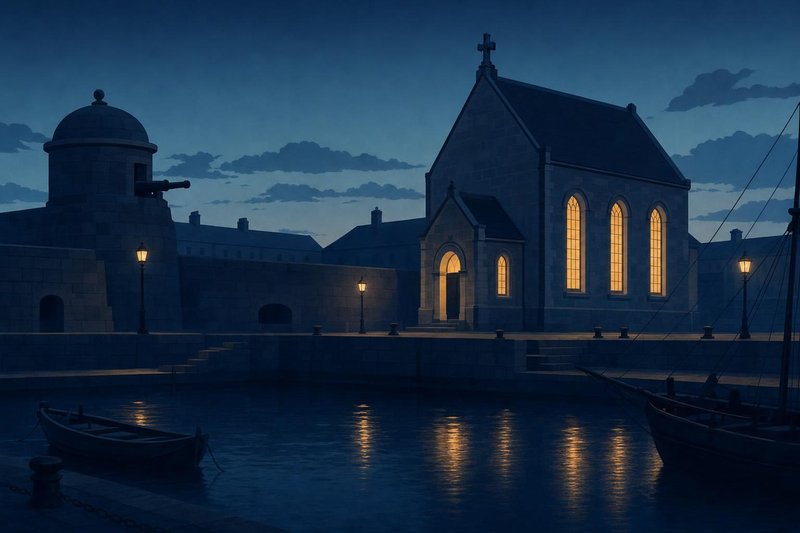
The Pembroke Dock Heritage Centre occupies the former Royal Dockyard Chapel, a late Georgian building inside the walls of the old naval yard. It is the town’s museum, and for many visitors the reason to come: the place where the flying boats, the shipbuilding and the strange episode of a starship built in a hangar are brought together under one domed roof.
What the Pembroke Dock Heritage Centre covers
It is a local museum of maritime, military and social history, covering roughly two hundred years of the town. The flying boats of RAF Pembroke Dock are the best-known part, but they are only one part.
The centre’s own description is of more than 200 years of maritime, military and social history, and the displays follow that order loosely. There is the royal dockyard, which launched five royal yachts and 263 other Royal Navy vessels between 1816 and 1922. There is the garrison that guarded it. Then there are the RAF years from 1930 to 1959, when the haven was full of flying boats, and the town’s life in between and since.
The museum is run by a volunteer-led charitable trust. Older accounts and the Wikipedia article on the dockyard name the operator as the Pembroke Dock Sunderland Trust; the charity’s own website now uses the name Pembroke Dock Heritage Trust. In July 2023 the Pembroke Dock museum achieved the UK Museum Accreditation Standard, which in Wales is administered by the Welsh Government. As part of that work the trust built new secure storage for objects and wrote a set of new policies.
People often look for a Sunderland flying boat museum when they plan a trip to west Wales, and this is the closest thing to one in the country. It is not, though, a hangar full of aircraft. The scale is that of a chapel, and the displays are made of parts, models, documents and personal objects rather than whole machines.
The chapel: a Georgian building at the end of the Terrace
The building is itself one of the exhibits. It was designed around 1830 by George Ledwell Taylor, Civil Architect to the Navy, and opened in 1831.
The chapel was first proposed in a plan of 1820, but Taylor’s drawings date from 1830. It is a late Georgian classical building in unpainted stucco with limestone details, a slate roof and a domed square tower at its west end. The west front has a projecting pedimented centre, and the long sides have tall arched windows, some still with their original iron glazing. In 1844 an avenue and gardens were laid out leading to the west front.
What makes it special is its setting. It stands at the end of the Terrace, the row of Georgian houses built for the dockyard officers, and was the centrepiece of that formal layout. Cadw lists it at Grade II* and describes it as thought to be the only Georgian classical church to survive in South Wales; the county’s tourism listing goes further and calls it the UK’s only remaining Georgian military chapel.
The chapel was brought back into use as the heritage centre with Objective One funding from the European Union, and the National Lottery Heritage Fund awarded £52,300 towards setting up and fitting out the interpretation inside. More recent work has included a major repair of the exterior, which the trust reported with photographs of scaffolding around the building.
Flying boats: the Sunderland at the centre
The Short Sunderland is the aircraft most visitors come to see, and the centre gives it pride of place. Its best-known exhibit is a full-size replica Sunderland cockpit.
The cockpit has working controls that allow a simulated flight over the estuary of the Milford Haven waterway. It is an unusual thing to find in a chapel, and for most people the nearest they will come to the flight deck of a Sunderland. Around it the displays set out the story of the flying boats at Pembroke Dock: the arrival of the RAF on 1 January 1930, the Sunderlands that replaced older types from 1938, and the war years, when the station became the largest operational flying-boat base in the world and at one point was home to 99 aircraft.
The aircraft protected Allied convoys in the Battle of the Atlantic, flying long patrols over the sea from the haven. The Pembroke Dock Heritage Centre tells that story through the people as well as the machines, which is where its collections come in.
Those people were not only British. In June 1940 Dutch naval seaplanes escaped to Pembroke Dock as the Netherlands was overrun and became No. 320 (Netherlands) Squadron there, and Australian, Canadian and United States Navy aircrews also flew from the haven during the war. Their part in the station’s story is told in the article on Pembroke Dock’s RAF history.
Sunderland T9044: parts from the seabed
Some of the most striking objects in the museum came up from the haven itself. They belong to Sunderland T9044, which sank off Pembroke Dock in a storm in 1940.
The wreck lies in about 18 metres of water and was rediscovered decades after the loss. Parts of the airframe have since been lifted, cleaned and put on display, and the trust describes many parts of the aircraft as now on view. The full story of the aircraft, its loss and the recovery work is told in the article on Sunderland T9044.
In June 2025 a new display was added around Wing Commander David Burrows, the last navigator on board T9044 before it sank at its moorings. His family gave his logbook, uniforms and other memorabilia, which now sit alongside other T9044 artefacts. A logbook is a modest object next to an engine part, but it is the kind of thing that turns a serial number back into a crew.
The Millennium Falcon display
The centre has a permanent exhibition on the building of the full-size Millennium Falcon for The Empire Strikes Back. The ship was built at Pembroke Dock in 1979, inside one of the former flying-boat hangars.
The exhibition follows the Falcon from early designs through construction to its journey across the country to the film studio. According to the county tourism listing, it includes photographs, models and film sequences not previously shown in public. The full story of the build, and why it happened in a flying-boat hangar in west Wales, is told in the Millennium Falcon article.
The dockyard, HMS Erebus and the town
Beyond the aircraft, the centre covers the royal dockyard and the town that grew up around it. Recent exhibitions have looked at ships built here and at the people of the town.
A 2026 exhibition, HMS Erebus: from dockyard to discovery, showed artefacts from the bomb vessel completed at Pembroke in 1826. Erebus later sailed to the Antarctic and was lost with Sir John Franklin’s Arctic expedition; her wreck was found in 2014. The royal yachts built at the yard also feature. There were five of them over the yard’s 112 years, the best known the two ships named Victoria and Albert, launched in 1855 and 1899. The Pembroke Dock Memorial Window installation is another of the centre’s highlights.
For a short guide to how the dockyard, the garrison and the RAF fit together, the brief history of the town sets out the main dates.
Collections: uniforms, medals and logbooks
The collections grow mostly through gifts from families and former servicemen. Uniforms, medals, logbooks and personal papers make up much of what is on show.
Recent gifts give a sense of the range. In 2022 an RAF airman’s campaign medals were given to the centre to go on display with his story. In October 2025 a retired Royal Navy commander, Fred Hatton, gave his uniform tunic and cap; he was the penultimate naval officer to command the Pembroke Dock base, and the trust described the gift as an important addition to its Royal Navy collection. The T9044 material, with its logbook and uniforms, comes from the same tradition of families handing objects on.
The trust’s newsletter has also followed local people whose RAF careers took them far from the haven. Air Commodore Paul Crotty, born in 1941 and a pupil at Pembroke Grammar School from 1952 to 1959, joined the Royal Air Force in 1962. In the mid-1980s he commanded RAF Stafford, with some 1,500 civilians and 1,000 airmen under him, a posting recorded in the trust’s Webfooter newsletter for 2017. He later ran logistics at Strike Command during the first Gulf War, served seven years as president of the Royal Air Force Association in Wales, and was appointed CBE in the 1996 New Year Honours after retiring from the service in 1995.
This is what gives the Pembroke Dock museum its character. The large themes are well known. The collections bring them down to individual lives: a navigator, an airman, a naval officer from the town.
Visiting the heritage centre
The centre stands inside the old dockyard, at Royal Dockyard Chapel, Meyrick Owen Way, Pembroke Dock, SA72 6WS. Visiting is easiest combined with a walk around the dockyard wall and the waterfront.
Opening is seasonal and times change from year to year, so check the centre’s current opening times before travelling, particularly in winter. Guides at the centre are volunteers, and the displays reward an unhurried visit rather than a quick look.
Visiting the town by train or ferry is straightforward: Pembroke Dock station is at the end of the branch line from Swansea, and ferries link the port with Rosslare. For getting there, a walking route and what else to see nearby, the guide to visiting Pembroke Dock covers the rest of the day. Anyone treating the trip as a visit to a Sunderland flying boat museum should allow time for the waterfront too, where the two listed hangars still stand.
The Sunderland that left town
Pembroke Dock once had a whole Sunderland on show, not just parts. It did not stay.
In 1963 the French Navy presented a Sunderland, formerly of No. 201 Squadron, to the town. It was cleaned and repaired for display, but the aircraft suffered from age and from standing out in the weather, and in 1971 it was moved to the Royal Air Force Museum at Hendon in London, where it can still be seen inside. The Pembroke Dock Heritage Centre works with fragments, a cockpit and memories instead, which suits a chapel better than a hangar ever would.
Questions
Questions about Pembroke Dock Heritage Centre
Q.01Where is the Pembroke Dock Heritage Centre?
It is in the former Royal Dockyard Chapel at the end of the Terrace, inside the old dockyard. The address is Royal Dockyard Chapel, Meyrick Owen Way, Pembroke Dock, SA72 6WS.
Q.02Is the Pembroke Dock Heritage Centre a Sunderland flying boat museum?
In large part, yes. The Short Sunderland flying boats of RAF Pembroke Dock are one of its main themes, with a full-size replica cockpit and recovered parts of Sunderland T9044, but the centre also covers the royal dockyard, the garrison and the town.
Q.03Who runs the heritage centre?
A volunteer-led charitable trust. Sources name it as the Pembroke Dock Sunderland Trust; the charity's own website today uses the name Pembroke Dock Heritage Trust. The museum gained UK Museum Accreditation in July 2023.
Q.04Can you see the Millennium Falcon at the museum?
Not the ship itself, which no longer exists. The centre has a permanent exhibition on how the full-size Falcon for The Empire Strikes Back was built at Pembroke Dock in 1979.
Q.05When is the museum open?
Opening is seasonal and times change, so check the centre's current times before travelling, especially in winter.
Related stories · Further along the waterfront
- 01T9044: the Sunderland on the seabedThe storm of 1940, the wreck in the haven and the parts brought back up.Read
- 02Welsh memories of the Millennium FalconHow a flying-boat hangar became a film workshop in 1979.Read
- 03Visiting Pembroke DockPembroke Dock rewards a slow half day. The dockyard, its towers and the flying-boat hangars are all within…Read